


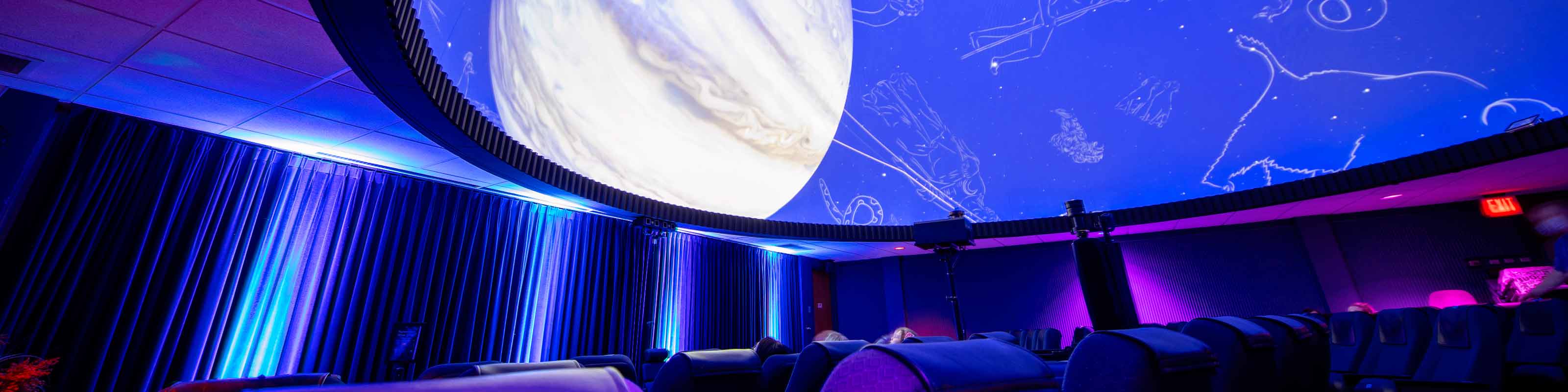
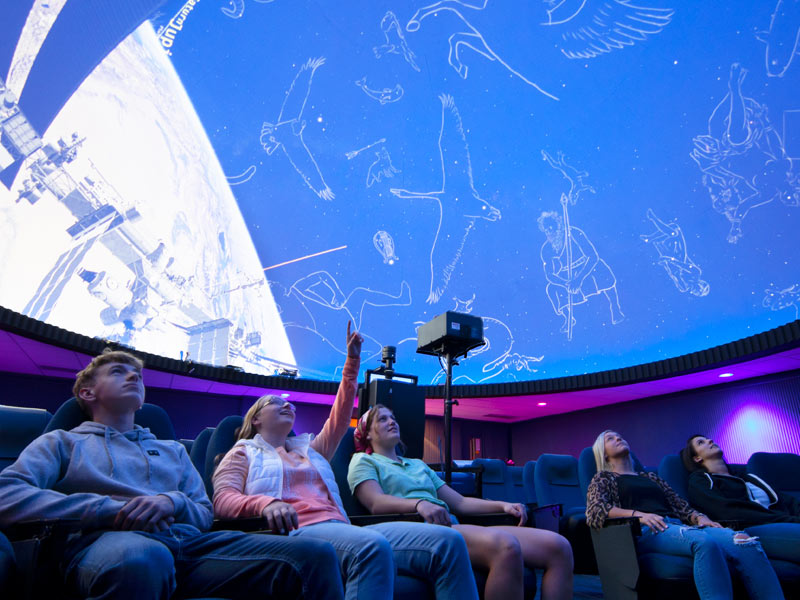
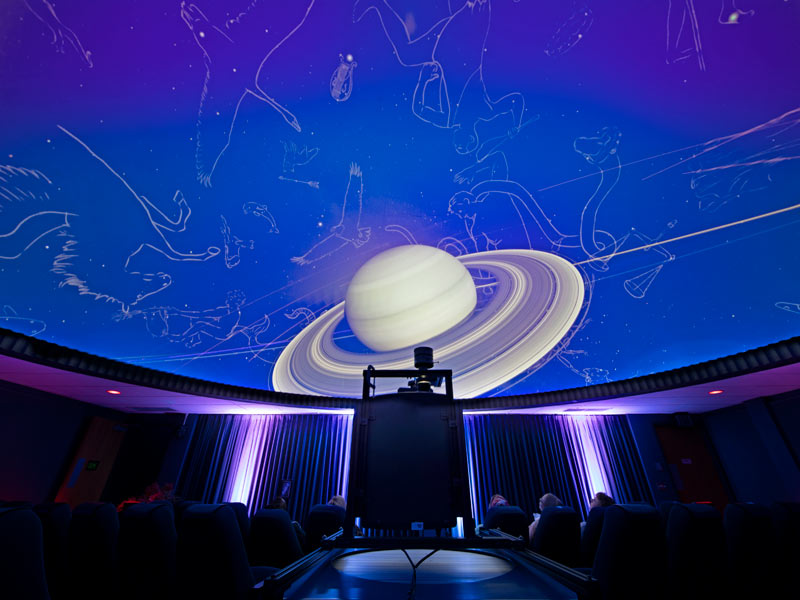
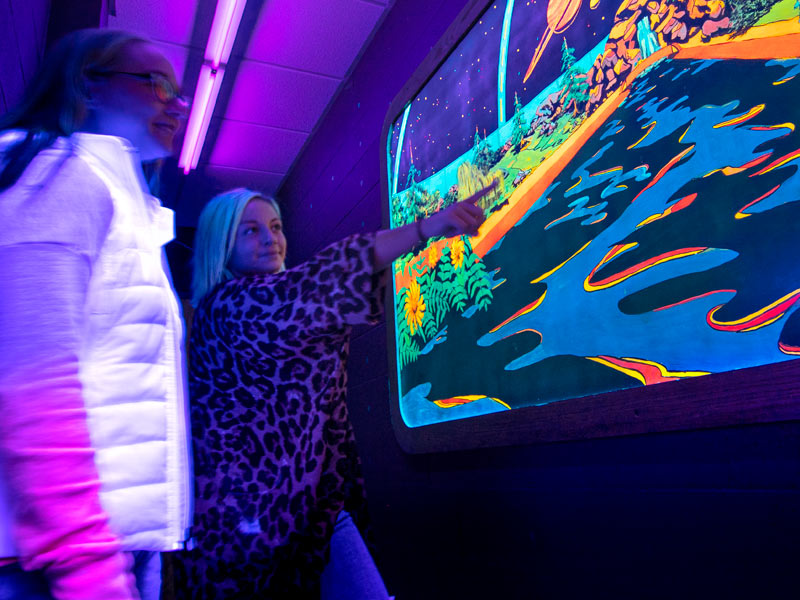
The Southwest Minnesota State University Planetarium is a theater of the universe. It can surround you with an accurate image of the sparkling night sky as well as display the complex motions and cycles that take place around us. State-of-the-art technologies create a fully immersive multimedia experience.
The three primary projection systems include a laser phosphor digital full-dome system, an LED-driven optical-mechanical star projector offering the most pristine look at the night sky, as well as a full-color laser light show system that can fill the entire dome with mesmerizing laser light. To augment this experience, a powerful audio system enhances the impact of the experience as you take in the wonders of the cosmos. This unique experience will interpret the universe in a way that appeals to both the mind and the eye. The Planetarium will introduce you to a lifelong acquaintance with the sky and the dynamic universe we are a part of.
To book a group planetarium star show and/or laser light show by contacting the planetarium director:
Ken Murphy
ken.murphy@smsu.edu
Follow Us On: Facebook Icon Facebook

| Date | Event |
|---|---|
| January 3 | Earth at perihelion, closest point to the sun, 91.4 million miles; Supermoon, 7% bigger than average full moon |
| January 5 | Latest sunrise: 7:19 a.m. CST in Marshall |
| January 6 | Venus at superior conjunction—behind the sun—moving to the evening sky |
| January 9 | Mars at superior conjunction—behind the sun—moving to the morning sky; Jupiter at opposition, opposite the sun, visible all night |
| January 19 | 20th anniversary of New Horizons launch to Pluto; arrived July 2015 |
| January 28 | 40th anniversary of the tragic Space Shuttle Challenger disaster |
| February 5 | Possible Launch of Artemis II—10-day, four-crew mission to orbit the Moon |
| February 11 | 10th anniversary of the discovery of Gravitational Waves, 100 years after Einstein's prediction |
| February 17 | Chinese New Year—Year of the Horse; second new moon after winter solstice; annular solar eclipse—Antarctica, south Indian Ocean, not visible in Marshall |
| March 3 | Total Lunar Eclipse! 3:50 a.m. to 6:27 a.m. |
| March 8 | Venus and Saturn close in the evening sky; “spring ahead!” Daylight Saving Time begins |
| March 10 | 20th anniversary Mars Reconnaissance Orbiter arrives at Mars, still working |
| March 14 | Pi Day and Einstein's birthday |
| March 20 | Spring begins at 9:46 a.m. CDT |
| March 25 | Saturn at solar conjunction—behind the sun—moving to the morning sky; 30th anniversary of Comet Hyakutake's closest approach to Earth, 9 million miles |
| April 11 | 40th anniversary of Halley's Comet closest to Earth, next pass will be in 2061 |
| April 12 | 45th anniversary of the first space shuttle launch—Columbia |
| April 19–21 | Mercury, Mars, and Saturn close in the morning sky |
| April 28 | 25th anniversary of the first space tourist, Dennis Tito's trip to the space station (ISS) |
| May | NASA's Psyche spacecraft gets a gravity assist at Mars to reach the Psyche asteroid in 2029 |
| May 5 | 65th anniversary of the first American in space—Alan Shepard |
| May 29 | The two brightest planets are getting close in the evening sky |
| June 8 | Venus and Jupiter are closest in the evening sky |
| June 13 | Earliest sunrise, 5:44 a.m. CDT in Marshall |
| June 21 | Summer solstice starts at 3:25 a.m. CDT |
| June 27 | Latest sunset, 9:08 p.m. CDT in Marshall |
| July 4 | 10th anniversary of the NASA spacecraft Juno orbiter arriving at Jupiter |
| July 6 | Earth at aphelion, the farthest point from the sun, 94.5 million miles |
| July 20 | 50th anniversary of the first lander on Mars—Viking 1 |
| July 26 | Pluto at opposition |
| July 29 | Jupiter at solar conjunction—behind the sun—moving to the morning sky |
| July 31 | 55th anniversary of the first Lunar Rover, or moon buggy, Apollo 15 |
| August 12 | Partial solar eclipse Marshall—1% 12:04 p.m. to 12:48 p.m.; totality for Iceland and Spain |
| August 12–14 | Perseids meteor shower peaks |
| August 15 | Jupiter and Mercury close in the morning sky |
| August 24 | 20th anniversary of Pluto reclassified as a dwarf planet by the International Astronomical Union (IAU) |
| August 27–28 | Almost total lunar eclipse! 9:33 p.m. to 12:51 a.m. |
| September 22 | Fall arrives with the autumnal equinox at 7:05 p.m. CDT |
| September 25 | Neptune at opposition |
| September 29 | Jupiter Icy Moons Explorer Juice (ESA) gravity assist Earth, arrives at Jupiter in 2031 |
| October 3 | Saturn is at opposition, opposite the sun, visible all night |
| October 24 | Venus is at its inferior conjunction, between Earth and the Sun, moving to the morning sky |
| November | BepiColombo (ESA & JAXA) spacecraft enters orbit of Mercury |
| November 1 | “Fall back!” Daylight Saving Time ends |
| November 14 | 55th anniversary of the first orbiting spacecraft at Mars, Mariner 9 |
| November 16 | Jupiter and Mars close in the morning sky |
| November 24 | Supermoon, 7% bigger than average full moon |
| November 25 | Uranus at opposition |
| December 3 | NASA's Europa Clippers gravity assist Earth, arrives Jupiter in 2030 |
| December 8 | Earliest sunset, 4:43 p.m. CST in Marshall |
| December 12–14 | Geminid meteor shower peaks |
| December 21 | Winter solstice starts at 2:50 p.m. CST |
| December 23 | Supermoon, 7% bigger than average full moon |
| December 31 | Sirius is opposite the sun, up all night |
Mercury makes its best evening appearances in late February and all of June. For morning watchers, the best time to catch the smallest planet is late July/early August and mid-November.
Venus slowly becomes visible in the evening sky about mid-February. Look for the brightest planet all spring and summer as it fades back toward the sun in mid-September. Venus quickly returns to the morning sky in November and December.
Mars is still too close to the sun to be seen until late April. Then, look low in the east in the morning sky. The red planet slowly gets higher in the morning sky. By the end of the year, Mars rises at about 10 p.m.
Jupiter is at opposition on January 10 and is above the horizon all night. By early May, the biggest planet sets about midnight. By the end of July, Jupiter is behind the sun and not to be seen. Look for the second-brightest planet in the morning sky at the end of August.
Saturn hangs on in the evening sky until mid-March and then slowly disappears behind the sun. The ring jewel returns to the morning sky by late April. By late July, it rises by 10 p.m., and by early October, it is at opposition, visible all night long.