
Dr. Sonya Vierstraete is 2026 Cowan Award Recipient
Published Friday, April 10, 2026
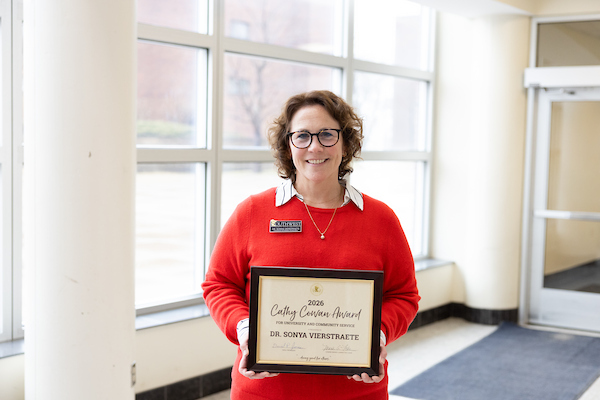
Southwest Minnesota State University has named Dr. Sonya Vierstraete, chair of the School of Education, as the 2026 recipient of the Cathy Cowan Award for University and Community Service. The award recognizes employees whose contributions reach beyond their formal job descriptions—service that strengthens the university, engages the broader community, and helps others succeed.
Vierstraete didn’t walk into the Meet and Confer meeting expecting recognition. She walked in a few minutes late as she had made unscheduled time for an advisee who needed to talk. It was the kind of interruption she would call normal: students first, details handled, then on to the next item.
The room felt unusually quiet as President David Jones paused the agenda. “We have a very important announcement,” he said. Vierstraete remembers thinking, “I think it’s all important.” Moments later, he said her name. She had checked the agenda; her name wasn’t on it. And then, as the surprise took shape—School of Education colleagues, her teacher candidates, and her own sons walking in—she sat stunned, trying to catch up to a moment she hadn’t seen coming.
The Cathy Cowan Award recognizes exceptional service that reaches beyond a job description: commitment to the university, engagement with the broader community, and leadership that makes others stronger. For Vierstraete, being named the 2026 recipient has been both affirming and unsettling.
“This is an elite group and I’m not quite sure if I’m worthy of being part of such an amazing collective of Mustangs,” she said. “I need to continue to try to be worthy of it in the future.” Days after the announcement, she described the feeling as “a little bit of almost like imposter syndrome”—the instinct to look at the work and think it’s simply what anyone should do.
At the same time, the award has turned her attention outward. “I truly am amazed by the work that happens across campus every day,” she said, framing the Cowan Award as a spotlight on service itself—not just a single person. In her view, recognition matters when it helps a community notice what it values and encourages more people to keep showing up.
Colleagues describe Vierstraete’s service as constant and contagious: a student-first leadership style that anticipates what’s coming next, notices where people need support, and treats challenges as opportunities to improve. In nomination letters, co-workers pointed to her humility. One said she “never asks others to assume responsibilities she is not already undertaking herself” and another pointed to the way she builds confidence in faculty and teacher candidates alike. One nominator summed up her influence with a line from A Leader’s Legacy: a true leader “liberates the leader in others.”
Vierstraete doesn’t deny the workload; she reframes it. “I’m energized by it,” she said. “Some people…see the work side of it. But I really enjoy being involved.”
That energy connects to a continuous-improvement mindset she repeats often: “When you know better, do better, and continue to get better.” And when frustration shows up, as it does in any complex system, she has a rule for what comes next: “You can’t really just complain about something. You need to have a solution and be part of the solution.”
The Cowan Award’s legacy is rooted in service that bridges the university and the community, and Vierstraete’s calendar reflects that same reach. Serving in multiple roles and on committees across campus, including the faculty association leadership, Vierstraete serves in the surrounding community. Locally, she has served with the Marshall Tiger football boosters—most notably as president for 10 years—before “newly” retiring and shifting her energy to the Marshall Tiger baseball boosters. She has served on the Junior Achievement board, supported fundraising efforts for the YMCA, and stayed active in her church community at the Church of the Holy Redeemer, where she has volunteered with projection support and helped with planning for school and church renovations. The thread, she said, is simple: “Just be a part of it.”
Her outreach also extends well beyond the region. Colleagues noted her role in building and sustaining international experiences for teacher candidates, including a long-standing partnership with El Colegio El Camino in Los Cabos, Mexico. Through that work, SMSU candidates have been able to pursue practicum and student-teaching opportunities abroad, supported by on-site supervision and intensive field experiences. Vierstraete has also helped support a student-teaching partnership with Internationella Engelska Skolan in Länna, Sweden, and contributed to the development of a pilot pathway with Ulster University in Ireland so future teachers can study and teach in international settings.
Vierstraete’s service also shows up in the regional and statewide networks that shape educator preparation. She participates in the SouthWest/West Central Service Cooperative Superintendents’ Executive Council and related teacher-preparation advisory efforts, where K–12 leaders collaborate on shared challenges. She has served on the Minnesota Association of Colleges for Teacher Education executive committee, and she remains active in literacy-focused professional groups, including the Minnesota Academy of Reading and the Southwest Reading Council, serving on two executive boards. Colleagues also highlighted her contributions to Minnesota’s Professional Educator Licensing and Standards Board (PELSB), including work as a program/unit reviewer and licensure-via-portfolio reviewer—roles that help ensure licensure standards are rigorous, fair, and responsive to Minnesota’s needs.
More recently, that work has become increasingly hands-on through teacher apprenticeship planning. In collaboration with partners such as Willmar Public Schools and other Minnesota stakeholders, Vierstraete has contributed to “earn while you learn” models designed to widen access for place-bound candidates and strengthen the educator pipeline. The goal is practical and values-driven at the same time: strengthen schools by expanding who can become a teacher—and by ensuring candidates are supported, mentored, and prepared along the way.
Asked why she says yes so often, Vierstraete traced it back to a line she has carried for years. In high school, while training for work as a lifeguard and swim teacher, she heard a motivational speaker lead a chant: “If it’s going to be, it’s got to be me. I am, I can, I will.” The phrase stuck—not as a slogan, she said, but as a way of moving through the world. “I’ve just always taken that approach that if it’s got to get done, somebody’s got to do it,” she said. “So let’s do it.”
That mindset shows up in how she talks about education itself. “The consistent piece is change,” she said—something she embraces rather than resists. Early in her career, she assumed lesson plans were something you created once and reused. “No, right?” she laughed. “The learners are different. The content changes a little bit.” Teaching, she said, is “never the same,” and the constant rethinking is part of what she loves. For her, the warning sign isn’t a hard year; it’s complacency. Once someone decides “this is good enough” and stops rethinking, she said, “then it’s time for a change professionally.”
Vierstraete is a Marshall native whose connection to SMSU began early through Postsecondary Enrollment Options courses. She remembers walking up the path to an afternoon class as a high school student and wondering what life might look like later—sensing that something exciting was ahead, even if she couldn’t name it yet. She completed her undergraduate degree at the College of St. Benedict, then returned to the Marshall area to begin teaching. Along the way, she kept coaching and mentoring—basketball, speech, and years of swimming and diving instruction and coaching that grew out of her own teenage work as a lifeguard and swim teacher.
As her K–12 career advanced—teaching, coaching, leading, and serving as a principal—she pursued graduate study as well, earning a master’s degree at SMSU and then completing doctoral work at the University of South Dakota. Her path back to the university began in the classroom: invited to teach a graduate course as an adjunct and then for several years, she eventually applied for a full-time position and joined SMSU faculty in 2010. Over time, she moved into department and school leadership, culminating in her current role as chair of the School of Education. Vierstraete has recently celebrated her twentieth year of service at SMSU.
In her teaching, Vierstraete’s focus is literacy—work she sees as foundational for everything that follows. She teaches courses such as Foundations of Literacy and Literature and Literacy Methods and Lab, drawing on experience as an elementary teacher and on ongoing work in multilingual learning and assessment. As Minnesota programs respond to the statewide emphasis on structured literacy and the “science of reading,” she has treated program review as an opportunity to strengthen what candidates experience every semester. The aim, she has said, is to prepare future teachers so that when they enter schools, they feel ready on day one—while also understanding that professional growth never stops.
Colleagues say that insistence on readiness shows up in the initiatives she has helped move from idea to implementation. In the last year, the School of Education has opened the Center for Learning Innovation with the Learning Innovation Lab, launched a Literacy Fellowship, and advanced the design of teacher apprenticeship programs, alongside the intensive self-study work connected to national accreditation. Just as important, Vierstraete encourages candidates to see themselves as advocates in a changing landscape—to speak up in school teams and pay attention to the decisions that shape classroom practice. If teachers live by the rules, she argues, they should be invested and help make them.
Those who work alongside Vierstraete describe a leader who lives in the space where vision meets detail. She returns often to purpose—what the program is doing and why—then moves to the practical work of documenting, assessing, and improving outcomes. Accreditation, in her view, is more than a stamp of approval; it is a structured way to identify what is strong and what needs to become stronger. In 2025, the School of Education earned national accreditation through the Association for Advancing Quality in Educator Preparation (AAQEP), a milestone colleagues credit in part to her ability to keep systems steady even amid limited time, budgets, and staffing.
She is also known for turning good ideas into structures that last. Colleagues pointed to efforts connected to the Center for Learning Innovation and other program investments that support state-of-the-art learning experiences for teacher candidates. They also highlighted grant-writing and coordination work aimed at expanding who sees teaching as a viable path, including initiatives intended to widen opportunities for BIPOC students and develop residency-style or apprenticeship pathways with area districts. Internally, she has helped guide work such as adopting a new lesson plan template, revisiting the School of Education’s conceptual framework, and preparing for a strategic plan aligned with the university’s direction—steps designed to make progress continuous rather than last-minute.
Even as she appreciates the Cowan Award, Vierstraete has been candid about the pressure that can come with being singled out. She has described the feeling as a kind of imposter syndrome—an internal insistence that she is “just doing the work.” Yet she also sees the award as a charge: to keep honoring the values behind it and to elevate others whose service is equally essential. Because she is so intrinsically motivated, she has said she has had to learn that recognition matters for others, too—and that leaders have a responsibility to make good work visible. Sharing stories, she believes, is not about empty praise; it is about noticing what is happening, naming it, and helping others feel seen.
At home, Vierstraete jokes that the improvement mindset doesn’t always switch off. She loves projects, home remodeling among them. But the impulse behind the projects is the same one behind her service: “If somebody’s got to do it, let’s do it,” she said. “Just be a part of it.”
She tries to pass that on to her children, too: “If there’s someone that you can help be an advocate for, be that person.” And when something needs to change, she allows for a moment of honesty, you can complain about it for a minute but not for staying stuck. The next step is to “find a solution or be a part of a solution or at least be part of the brainstorming.”
The choice, she said, shows up daily: “Every day is happening. You pick how you approach the day.” She lives out that philosophy in all areas of her life as she makes her home in Marshall with her husband, Dustin, who was also her high school sweetheart. They are parents to three adult sons: Jackson, Jonah, and JR.
The Cathy Cowan Award for University and Community Service is presented to a faculty or staff member and is the most prestigious annual award given at Southwest Minnesota State University. It is named for the late Cathy Cowan, a Psychology professor who died in an auto accident in December 2001. Cowan’s example of service to SMSU students and the community was the inspiration for the award. A big criterion is ‘doing good for others.’
Vierstraete will be honored at the annual Mustang Ovations event on Tuesday, April 14, 2026 at 3:00pm in the Conference Center Upper Level at SMSU.
Related Articles


A Night of Poetry with Florence Dacey and Michael Bazzett on Oct. 22
Posted on 10-14-2026